English
 Français
 Español
MTU Powered Diesel Generator Sets: Key Specifications for Large-Scale Power Systems
Oct 22, 2026
Content
- 1 What Counts as an MTU Powered Diesel Generator Set
- 2 MTU Series 1600, 2000 and 4000: Output Bands at 50 Hz
- 3 Key Specifications to Write Into the Purchase Order
- 4 Load Acceptance and Motor Starting: Where Large Sets Fail
- 5 Fuel, Emissions and Running Cost at 2,000 kVA
- 6 Container, Silent, Open or Trailer: Matching the Set to the Site
- 7 Documentation and Verification Before Shipment
- 8 Practical Questions from Project Teams
A 2,000 kVA standby set is not judged by its nameplate. It is judged in the seconds after the transfer switch closes, when a data hall, a hospital block or a process line throws its entire load onto the generator in one step. Either the set absorbs that block inside ISO 8528-5 limits, or the breaker trips and the site loses power twice.
MTU powered diesel generator sets sit at the top of the land-based output range, and the specifications that separate a workable package from an expensive mistake are electrical and thermal rather than mechanical. The engine families, the figures that belong in a purchase order and the points where large-scale projects most often go wrong are set out below.
What Counts as an MTU Powered Diesel Generator Set
An MTU powered diesel generator set is a packaged unit built around a Rolls-Royce Power Systems MTU diesel engine, coupled to a synchronous alternator on a common baseframe and governed by one integrated control system. Every other component is sized against the engine rating, not the other way around.
A set is correctly rated only when three figures are declared at the same load point and the same ambient temperature: the engine rating to ISO 3046, the generator set rating to ISO 8528-1 as COP, PRP or ESP, and the alternator rating to IEC 60034-1. A datasheet that quotes only one of the three cannot be compared with another.
MTU's power generation line rests on three families carrying the Series 1600, Series 2000 and Series 4000 designations. Electronic engine management meters fuel delivery across the whole load range, and the larger Series 4000 cylinder variants add common-rail injection with two-stage turbocharging. The practical result is specific fuel consumption between 195 and 215 g/kWh at rated load and lube oil consumption under 0.3 percent of fuel consumption, which matters far more on 4,000 hour per year prime duty than on 200 hour standby duty.
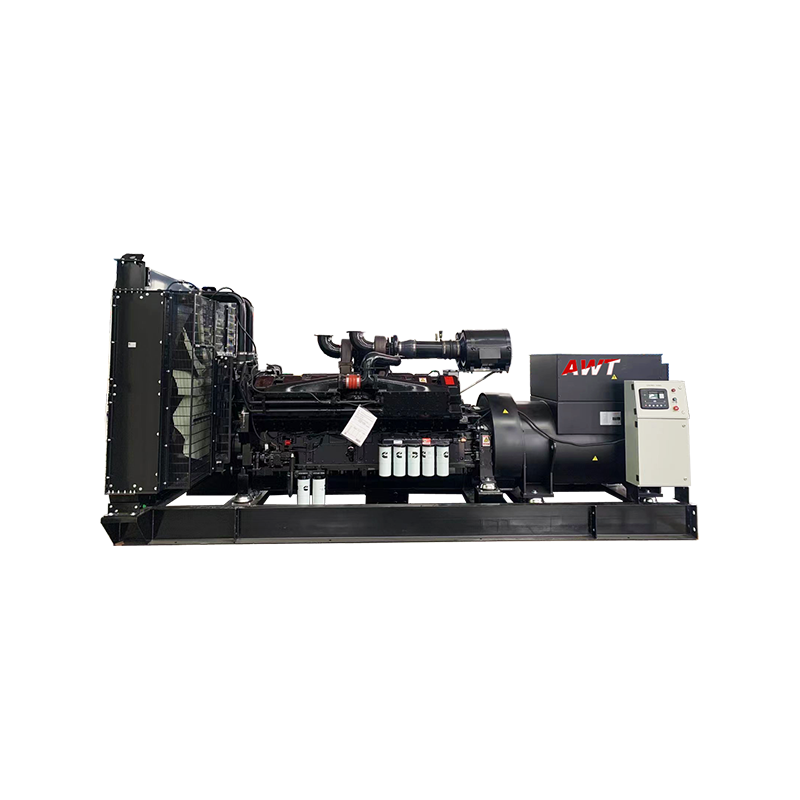
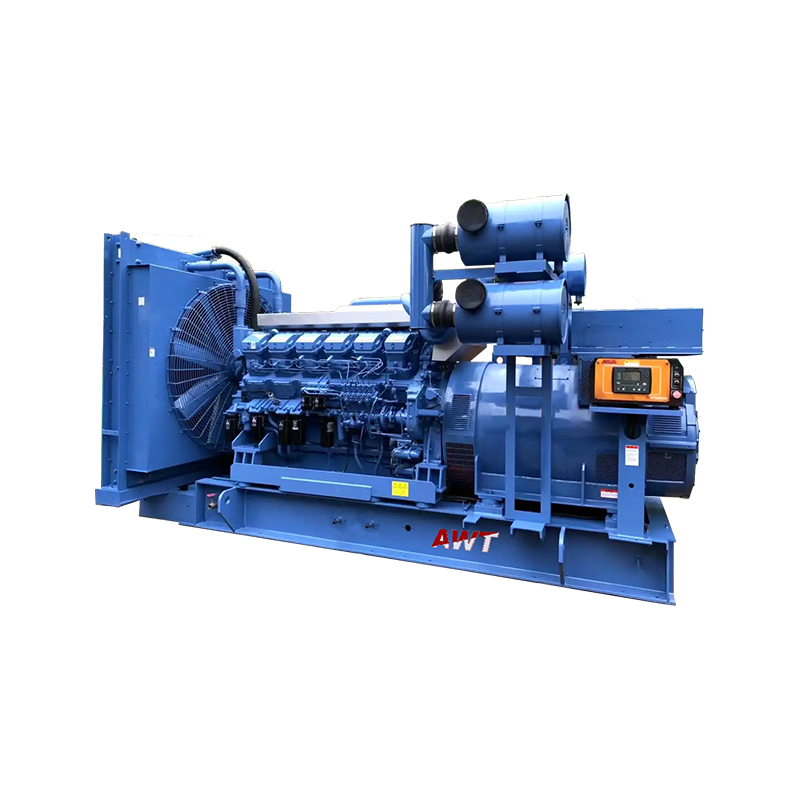
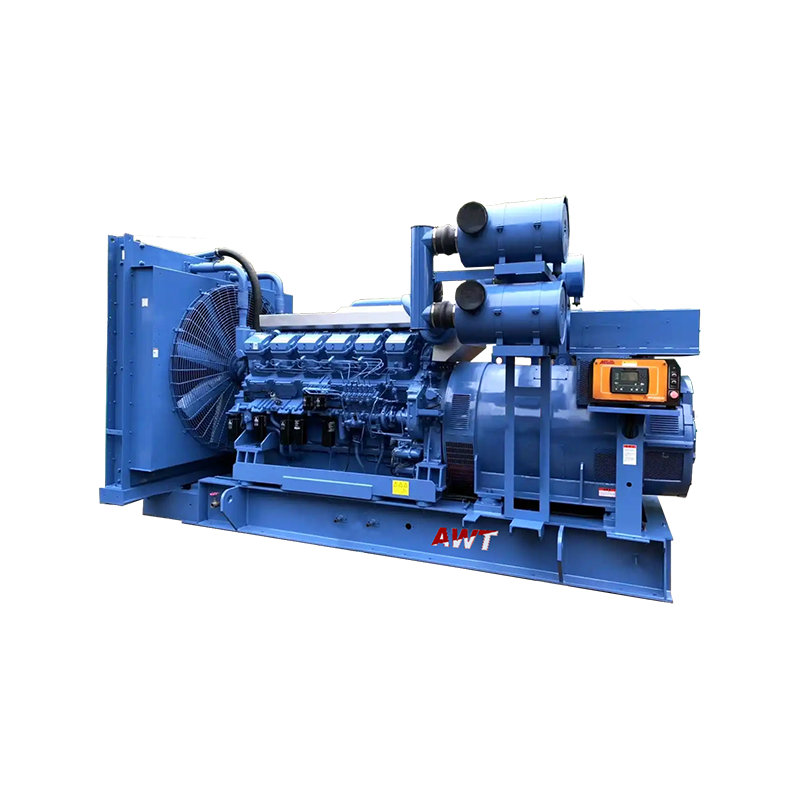
 MTU Powered Diesel Generator SetsComplying with ISO 8528 and GB/T 2828 industry standards, these gensets are equipped with authentic MTU high-end industrial engines, high-precision full-copper brushle...View Product →
Yangzhou Aiweite Electromechanical Co., Ltd. has built land-use diesel generator sets from 1 kVA to 2,500 kVA since 2008 and assembles MTU-based packages with a choice of enclosure format, alternator and control philosophy.
MTU Series 1600, 2000 and 4000: Output Bands at 50 Hz
At 50 Hz the three MTU families cover roughly 220 kVA to more than 3,000 kVA, enough for a 400-bed hospital, an airport terminal or a cement plant emergency busbar without resorting to paralleled units.
Displacement explains most of the behavioural difference. Series 2000 uses a 130 mm bore and a 150 mm stroke, so 2.0 litres per cylinder, giving 15.9 litres at 8V, 23.9 litres at 12V and 31.8 litres at 16V. Series 4000 moves to a 165 mm bore and a 190 mm stroke, 4.06 litres per cylinder, giving 32.5 litres at 8V, 48.8 litres at 12V, 65.0 litres at 16V and 81.2 litres at 20V. Series 1600 is the four and six cylinder entry point for sites that need the same control architecture at lower output.
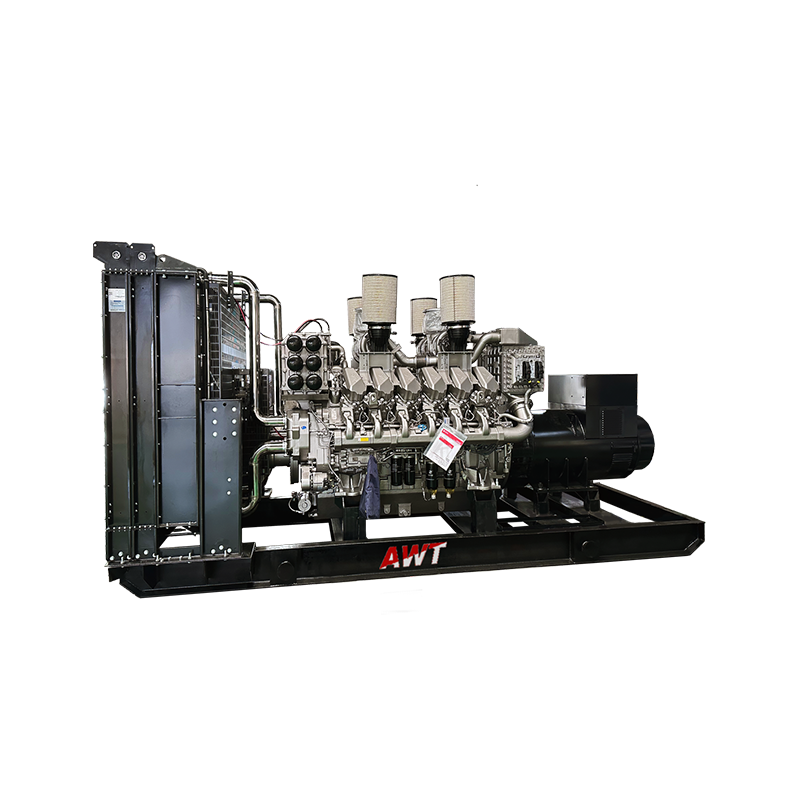
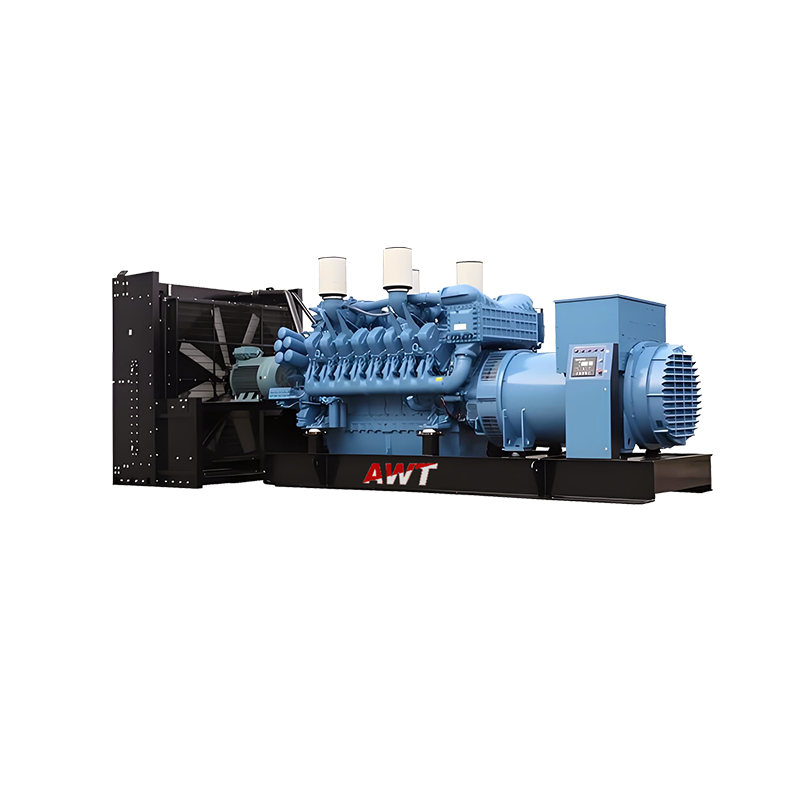
 1000kVA – 2500kVA Universal Diesel Generator SetsCompliant with ISO 8528 and GB/T 2828 international standards, these ultra-high-power gensets adopt premium heavy-duty industrial engines, large-capacity full-copper a...View Product →
More litres per kVA buys two things: a lower mean effective pressure at the same output, which extends overhaul intervals, and more rotating inertia during the first seconds of a step load, which is where transient performance is won or lost.
Key Specifications to Write Into the Purchase Order
The table below is the short list that decides approval on a large-scale project. Everything else on an MTU datasheet is secondary to these eight lines.
| Specification | Typical value | Why it decides the project |
| Rating basis | COP, PRP or ESP to ISO 8528-1 | ESP covers 200 hours a year at 70 percent average load; continuous duty on an ESP rating accelerates wear. |
| Speed and frequency | 1,500 rpm at 50 Hz, 1,800 rpm at 60 Hz | Frequency cannot be changed after build without a new alternator and new governor settings. |
| Steady-state output | 400 or 415 V three phase, plus or minus 1 percent voltage | Variable speed drives and imaging equipment need the tighter end of the band. |
| Transient deviation | Plus or minus 15 percent voltage at a 100 percent step, recovery in 3 to 5 seconds | This figure decides whether the transfer is invisible or shows on the site UPS. |
| Specific fuel consumption | 195 to 215 g/kWh at rated load | Across 1,600 kW of output the spread is 375 to 415 litres per hour. |
| Alternator | IEC 60034-1, class H insulation with class F temperature rise | A class F rise on class H insulation leaves thermal headroom for 40 degree ambient sites. |
| Emissions | EU Stage IIIA or Stage V under Regulation (EU) 2016/1628, or US EPA Tier 4 Final | The stage decides whether the package needs SCR, a particulate filter or neither. |
| Enclosure and mass | IP23 open set, IP44 or better in a container, 12 to 16 tonnes at 2,000 kVA | Crane capacity and road permits are often the longest lead item in the project. |
Load Acceptance and Motor Starting: Where Large Sets Fail
A set rated 2,000 kVA at 0.8 power factor delivers 1,600 kW of real power, and the load that decides whether it starts cleanly is usually one motor rather than the whole site.
ISO 8528-5 classifies load acceptance from G1 to G3. G1 places no requirement on transient deviation, G2 is the commercial default, and G3 applies where the voltage and frequency envelope must be held tightly because the load is critical. Data centre, hospital and airport specifications are almost always written to G3, whether or not the site needs it, and the extra cost lands on the alternator rather than the engine.
- For a direct-on-line motor, allow 2.5 to 3 times its kW rating in kVA when the set must start it while carrying other load.
- Star-delta and soft starters cut inrush to roughly one third of direct-on-line current, which can remove a full frame size from the alternator.
- Sequence the largest motor first, then the remainder, and frequency recovery stays inside 5 seconds on a G2 or G3 machine.
The only reliable proof is a load bank study. Ask for the transient waveform at 25, 50, 75 and 100 percent step loads before the set leaves the factory, not after it arrives on site.
Fuel, Emissions and Running Cost at 2,000 kVA
A 2,000 kVA set running at 1,600 kW and 200 g/kWh burns 320 kg of diesel per hour. At a density of 0.84 kg per litre that is about 380 litres per hour, or 76,000 litres across 200 hours of standby testing and outages in a year.
Emissions are set by the application, not by the engine. Under Regulation (EU) 2016/1628, non-road generating sets above 560 kW must meet Stage V, which on Series 4000 packages generally means selective catalytic reduction and a particulate filter. Low-hour emergency sets fall under national exemptions rather than the regulation itself, so the limit must be confirmed before the enclosure design is frozen.
Container, Silent, Open or Trailer: Matching the Set to the Site
Structural format, not engine brand, decides how a large package reaches the site and how long it survives once it is there.
Container packages are usually the correct answer for plants, infrastructure projects and emergency power duties because they arrive tested, with ventilation, cable entry and fuel connections already integrated. The same output is specified across industries with very different duty profiles, from water treatment to telecom sites, which is why the enclosure decision should be made before the engine rating is fixed.
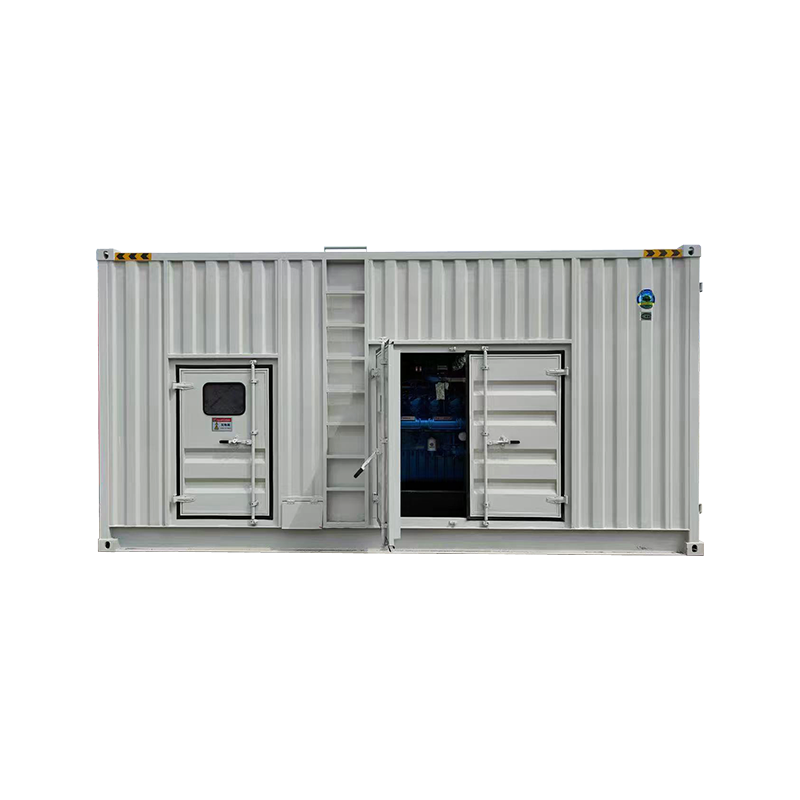 Container Type Diesel Generator SetsComplying with ISO 8528 industrial standards, container gensets adopt standard 20ft/40ft container shells based on heavy-duty open-type units. Pre-equipped with comple...View Product →
Documentation and Verification Before Shipment
Five documents decide whether a large MTU package can be commissioned without argument on site.
- A factory test report at 25, 50, 75, 100 and 110 percent load, with voltage and frequency traces attached.
- Type test certificates for the alternator to IEC 60034-1 and the engine emissions certificate for the applicable stage.
- An as-built wiring diagram whose terminal numbering matches the physical panel.
- Fuel, exhaust and ventilation drawings showing pressure drop at the set's rated airflow.
- A control system point list covering the transfer logic, alarm setpoints and remote signalling.
Buyers who need a rating outside the standard band, a specific alternator, a custom control philosophy or their own branding can use the manufacturer's OEM and ODM route instead of accepting a catalogue build. The mechanical platform stays the same from 1 kVA to 2,500 kVA; the variation lives in the control panel, the enclosure and the fuel system.
Practical Questions from Project Teams
How many kVA does a 1,200 kW site load need?
Divide by the power factor, then add margin. A 1,200 kW load at 0.8 power factor needs 1,500 kVA, so a set with a 1,500 kVA PRP rating and an 1,800 kVA ESP rating fits. Then check the alternator against the largest motor: a 250 kW direct-on-line start needs roughly 625 kVA of transient capability.
Which emissions standard applies to a large standby generator?
It depends on jurisdiction and annual running hours, not on kVA. Under Regulation (EU) 2016/1628, non-road generating sets above 560 kW must meet Stage V, normally with SCR and a particulate filter, while low-hour emergency sets fall under national exemptions that must be confirmed in writing.
Is a 1,500 rpm or an 1,800 rpm set better?
Neither is better in isolation: 1,500 rpm serves 50 Hz and 1,800 rpm serves 60 Hz, so there is no choice within a market. The 50 Hz package usually runs longer between overhauls because piston speed and wear per operating hour are lower.
How much fuel should be stored for a 2,000 kVA set?
At roughly 380 litres per hour at full output, an 8 hour run needs 3,040 litres. A 4,000 litre day tank plus a bulk tank covers a realistic outage, and many fire codes cap indoor day tanks at that size while requiring a bunded, vented room.
The specification work for a large MTU package is concentrated in four numbers: the ISO 8528-1 rating basis, the ISO 8528-5 load acceptance class, the specific fuel consumption at rated load and the transient voltage deviation at a 100 percent step. Get those four right and the rest of the package follows. Get them wrong and no amount of engine displacement will rescue the project.