English
  Français
  Español
 1000-2500 kVA Universal Diesel Generator Sets: Large-Scale Power System Guide
Oct 07, 2026
Content
- 1 What Defines a 1000-2500 kVA Universal Diesel Generator Set
- 2 Engine Platforms: Matching the Prime Mover to the Duty
- 3 Enclosure and Mounting Options for Large Sets
- 4 Sizing, Load Profiles, and Fuel Demand
- 5 Installation, Cooling, and Fuel System Requirements
- 6 Qualifying a Supplier for a Large-Scale Project
- 7 Frequently Asked Questions
Losing power for thirty minutes can shut a production line, stop a pumping station, or force a process restart that wastes hours. When the required capacity reaches 1000-2500 kVA, a universal diesel generator set is not a small accessory; it is a major electrical asset that must be specified, installed, and maintained like part of the plant itself.
This guide covers the engineering decisions behind large universal diesel generator sets in the 1000-2500 kVA band: rating definitions, engine platforms, enclosure types, load calculation, fuel demand, installation requirements, and supplier qualification. The figures below are the same numbers a competent manufacturer should be able to discuss in your first technical meeting.
What Defines a 1000-2500 kVA Universal Diesel Generator Set
A 1000-2500 kVA universal diesel generator set is a self-contained power unit that couples a diesel engine, alternator, control panel, radiator, and baseframe into one package rated for standby, prime, or continuous duty.
The word "universal" describes a general-purpose machine designed for a broad range of loads, including factory power, infrastructure projects, data centers, and emergency supply, rather than a specialized one-off build. Manufacturers such as Yangzhou Aiweite Electromechanical Co., Ltd. assemble these sets around multiple engine platforms and test them as complete generating units before delivery.
Core definition: A universal diesel generator set is a standard, pre-packaged engine-alternator assembly with integrated cooling, control, and protection, rated in kVA under ISO 8528 and intended for general power supply wherever the grid is absent or unreliable.
The rated number is not a single figure. ISO 8528 defines three duty classes: standby, prime, and continuous. The difference is the permitted load cycle and running hours, and it directly affects how many kVA you must buy.
| Rating class | Permitted load | Typical duty | Overload allowance |
| Standby | Up to rated output, average below 70% | Emergency backup when the grid fails | 10% for 1 h in every 12 h |
| Prime | Up to 85% average with variable load | Main power where load fluctuates | 10% for 1 h in every 12 h |
| Continuous | 100% rated load, no overload | Baseload or grid-parallel operation | None |
At 0.8 power factor, a 2000 kVA set supplies 1600 kW of active power, enough to carry a medium factory complex while absorbing the starting load of a 400 kW motor bank.
Engine Platforms: Matching the Prime Mover to the Duty
The engine determines fuel burn, service intervals, spare-part lead times, and the set's ability to accept sudden load steps, which makes it the most important specification decision in the 1000-2500 kVA band.
Yangzhou Aiweite Electromechanical Co., Ltd. builds universal sets on nine engine platforms: Baudouin, Cummins, Mitsubishi, MTU, Perkins, SDEC, Volvo, Weichai, and Yuchai. In the 1000-2500 kVA range, the platforms that appear most often are Baudouin, Cummins, Mitsubishi, MTU, Volvo, Weichai, and Yuchai. All are heavy-duty industrial engines, but they differ in price, parts availability, and electronic control complexity.
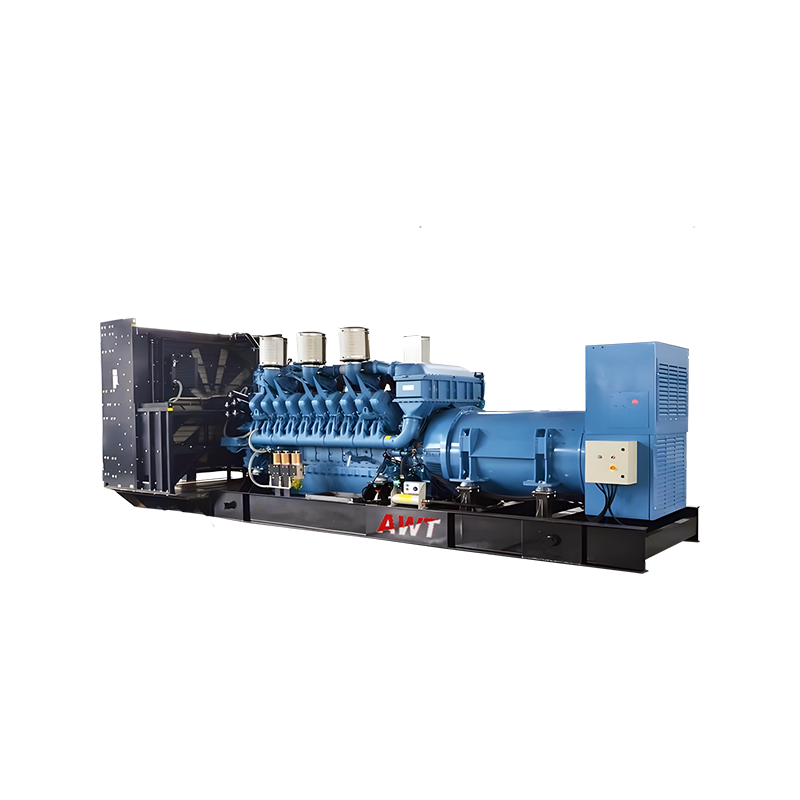
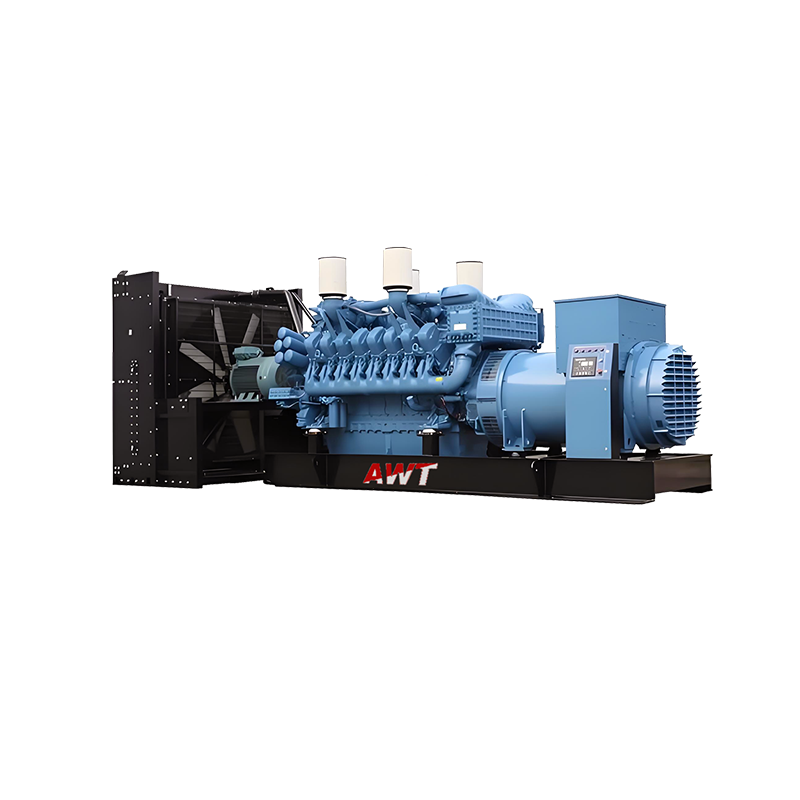 MTU-Powered Diesel Generator Sets for Mission-Critical PowerThese generator sets use genuine German MTU industrial engines with advanced electronic fuel injection, offering stable operation and rapid load response for data centers, hospitals, and key infrastructure projects.View Product →
Compare suppliers on four factors rather than on the engine name alone:
| Factor | Why it matters | What to verify |
| Fuel consumption | Fuel is the largest lifetime cost of the set | g/kWh curve at 25/50/75/100% load |
| Service interval | Determines planned downtime and consumables budget | Oil change hours and filter set cost |
| Parts lead time | Critical for remote project sites | Dealer warehouse location and stocked parts |
| Load acceptance | Large motor starts cause transient voltage dips | Step-load test result at 30-50% of rating |
Lifetime-cost reality: At 200 L/h and 1,000 operating hours per year, fuel spend can exceed the purchase price of a 1500 kVA set within twelve months. Two engines with the same kVA rating can differ by 5-8% in specific fuel consumption, which on a large set running 2,000 hours a year means tens of thousands of liters of diesel.
Enclosure and Mounting Options for Large Sets
The enclosure type decides where the set can operate, what noise the site will hear, and how the machine is transported, lifted, and protected.
Universal diesel generator sets in the 1000-2500 kVA band are available in four basic structures, each with a different total installed cost:
Open type
Lowest equipment cost; designed for an existing machine room. The room must provide acoustic treatment, ventilation, and fuel piping.
Silent type
Insulated canopy around the genset, typically reducing outdoor noise to 75-85 dB(A) at 7 meters depending on the model. Suited to sites with noise limits or limited building space.
Container type
Set installed inside a 20- or 40-foot ISO-style container with built-in fuel tank, control room, and service access. Handled by a standard container crane and ready for outdoor deployment.
Trailer type
Road-towable package for rental fleets, scheduled maintenance outages, and temporary power events. Includes its own frame, suspension, and towing connections.
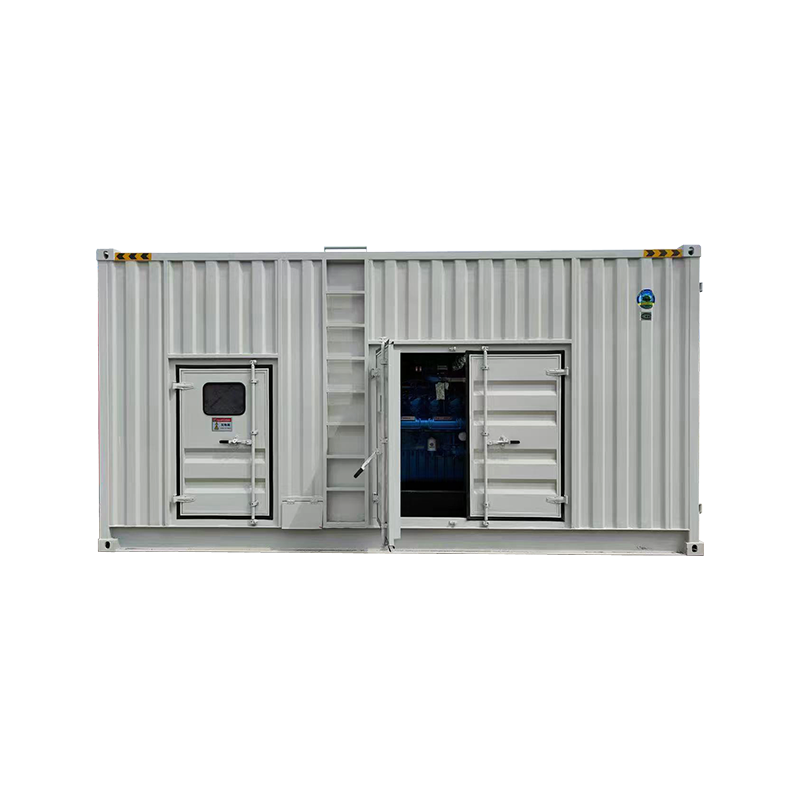 Container-Type Diesel Generator Sets for Rapid Outdoor DeploymentFully integrated standard container gensets with silencing, ventilation, and fire protection. Ideal for remote projects, they provide weather resistance, low noise, and quick installation without a machine room.View Product →
A container-type 1500 kVA set can be lifted on site in a few hours and put into operation without building a machine room. For most outdoor infrastructure projects, the container enclosure delivers the lowest total installation cost.
Sizing, Load Profiles, and Fuel Demand
Sizing a large generator set starts with maximum demand in kVA, not kW, then adds margin for the largest motor's starting current and future load growth.
Use a five-step method to convert a site load list into a generator rating:
- List all connected loads and their running kW.
- Apply a diversity factor of 0.7-0.9, typical for factories, to get the maximum coincident demand.
- Divide by the average power factor (0.8 typical) to convert kW to kVA.
- Add the starting kVA of the largest motor if no soft starter or drive is used.
- Check the resulting kVA against standby or prime rating and the planned annual running hours.
| Load type | Starting behavior | Sizing effect |
| Induction motors | 6x full-load current with direct-on-line starting; 2-3x with a soft starter | The largest motor often sets the minimum rating |
| HVAC compressors | High inrush; compressors may restart together after an outage | Sequence restart to avoid a simultaneous peak |
| UPS and drives | Low inrush but high harmonic content | Check alternator non-linear load capability |
| Pumps and fans | Low inrush if started with closed valves or dampers | Minor unless several start at the same time |
Typical fuel consumption of a 1500 kVA set at 0.8 power factor
A 1500 kVA set running at 75% load burns about 200 L/h. Over 300 eight-hour days, that is roughly 480,000 L of diesel, a figure that belongs in the project budget before the set is ordered, not after.
Installation, Cooling, and Fuel System Requirements
A correctly rated generator set will fail to deliver rated output if the site provides inadequate combustion air, restricted cooling airflow, or contaminated fuel, so installation engineering is part of the power system design.
- Foundation and mounting: Pour a reinforced concrete slab at least 200 mm thick, separate it from the building structure where vibration matters, and fit anti-vibration mounts before alignment.
- Combustion air: Supply about 0.1 m3/min per kW of engine output; a 1200 kW engine needs roughly 120 m3/min of clean combustion air.
- Cooling airflow: Radiator fans require 250-350 m3/min for a 1500 kVA set; ducting must not exceed the manufacturer's maximum static pressure.
- Exhaust system: Keep back pressure below the engine limit, typically under 10 kPa for turbocharged diesels, and size the silencer for flow rate, not pipe diameter.
- Fuel system: Install a duplex filter with a water separator, a day tank sized for 8-12 hours at rated load, and a return line that prevents suction air entry.
- Load bank test: Run the installed set under artificial load at 25/50/75/100% and record voltage, frequency, oil pressure, and coolant temperature before handover.
These conditions apply to every deployment site, from factory machine rooms to infrastructure projects and temporary power locations.
The most common cause of large-set failure is not the engine block; it is a machine room that restricts cooling airflow or a fuel system that delivers dirty diesel. Both are preventable at the design stage.
Qualifying a Supplier for a Large-Scale Project
For a project in this power band, the lowest purchase price is rarely the lowest total cost once load testing, documentation, commissioning, parts supply, and warranty support are included.
Ask every candidate manufacturer the same set of questions:
- Can you provide a load bank test report at 100% rated output for this exact set?
- Is the full documentation package, including wiring diagrams, datasheets, the measured fuel curve, and the maintenance manual, available before delivery?
- What is the realistic lead time for the set and for spare parts after commissioning?
- Does the installation scope include a site survey, foundation drawing, supervision, and commissioning?
Yangzhou Aiweite Electromechanical Co., Ltd. has manufactured and installed diesel generator sets since 2008, covering a capacity range from 1 kVA to 2500 kVA and serving factories, infrastructure projects, and emergency power supply. The company also operates an OEM/ODM program, so brand owners and project integrators can source standard or custom-branded units from a single manufacturer.
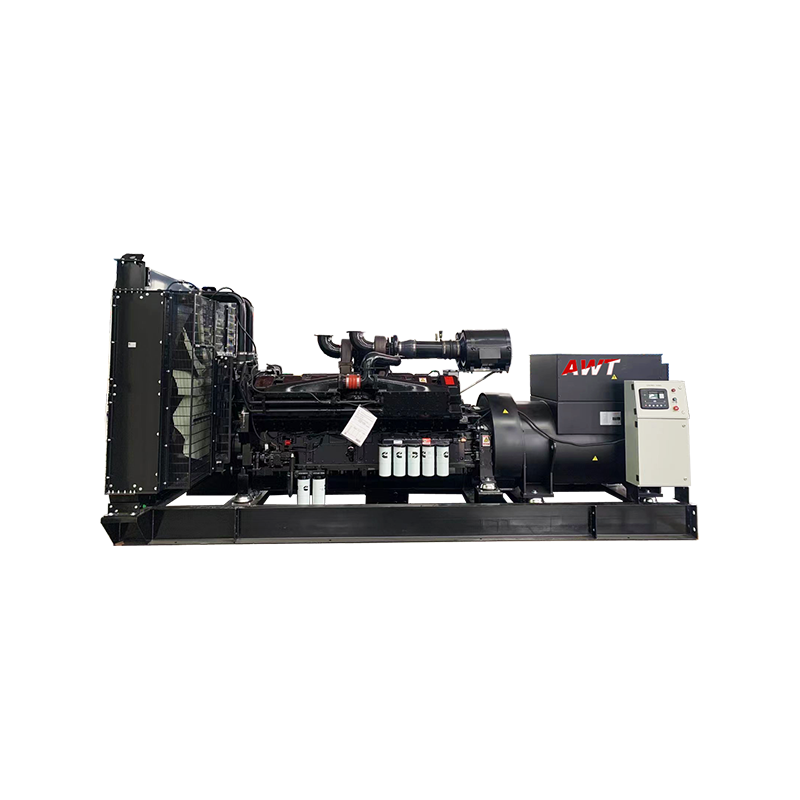
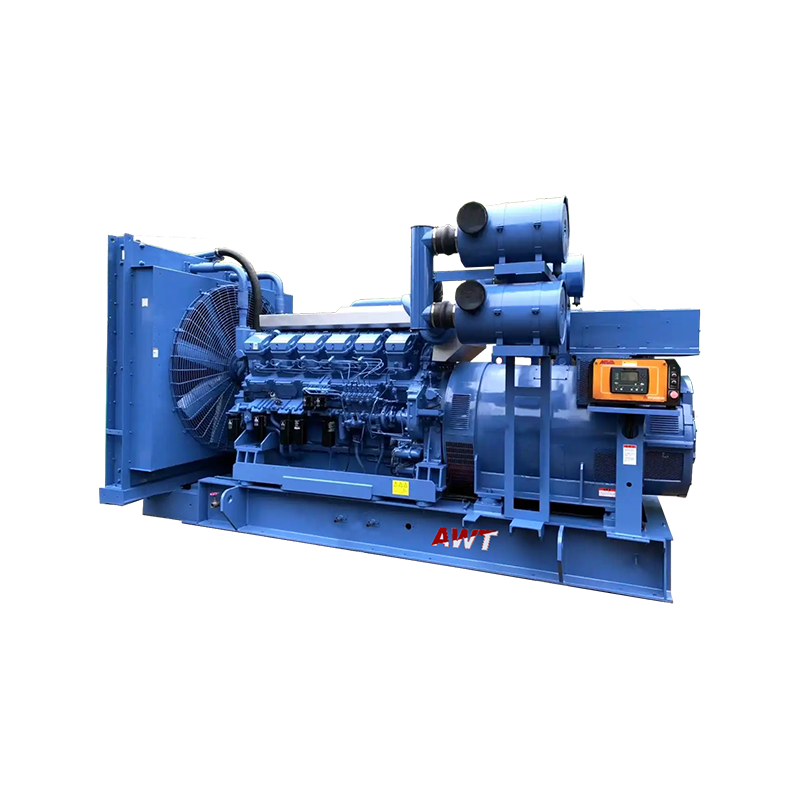 1000-2500 kVA Universal Diesel Generator Sets for Heavy-Duty UseUltra-high-power gensets with large-bore industrial engines and full-copper alternators, built for 24/7 full-load operation. Suitable for large industrial bases and national infrastructure projects seeking reliability.View Product →
A credible manufacturer should be able to show a step-load acceptance test at 75% of rating and a measured fuel curve from a real load bank run, not a brochure table.
Frequently Asked Questions
These answers reflect the questions most frequently raised during technical evaluation of 1000-2500 kVA universal sets.
How much fuel does a 1500 kVA generator set consume per hour?
A 1500 kVA set at 0.8 power factor running at 75% load burns roughly 200 L/h, or about 0.22 L/kWh. At 50% load, consumption drops to around 135 L/h, but specific consumption per kWh rises because the engine operates further from its most efficient zone.
Can 1000-2500 kVA generator sets be paralleled?
Yes. Large universal diesel generator sets can be synchronized in multi-unit paralleling for higher capacity or N+1 redundancy, provided the controls include speed governor and AVR outputs configured for load sharing, and the site has a common bus with coordinated protection.
What is the difference between standby and prime rating?
Standby rating assumes the grid is normally available and the set runs only during outages, with average load below 70%. Prime rating assumes the set is the normal power source. A standby-rated set must be derated, typically by 10-15%, before it can be used for continuous prime duty.
What voltage options are available for 1000-2500 kVA sets?
Low-voltage outputs of 400 V and 480 V are standard. For distribution-level use, medium-voltage configurations at 6.3 kV, 10.5 kV, or 11 kV can be supplied with matching alternators and protection. Confirm AVR settings and protection relay coordination for the exact grid configuration before ordering.