English
  Français
  Español
 1000-2500 kVA Universal Diesel Generator Sets: Key Procurement Specifications
Oct 09, 2026
Content
- 1 01Define the Rating: ISO 8528-1 Standby, Prime, Continuous
- 2 02Engine Specification: Speed, Displacement and Fuel Use
- 3 03Alternator and AVR: Voltage Regulation and Load Compatibility
- 4 04Cooling, Fuel Supply and Site Derating
- 5 05Enclosure, Noise and Site Integration
- 6 06Controls, Paralleling and Protection
- 7 07FAT, Documentation and Customization
- 8 08Straight Answers on Large Genset Procurement
An 1800 kVA standby-rated diesel generator set cannot feed a 1500 kW process line hour after hour. Under ISO 8528-1:2018, the standby rating assumes emergency duty only, limits the 24-hour average load to 70% of rated output, and permits no planned overload; the same machine configured for prime duty is normally rated about 10% lower.
This guide defines the specifications that matter when tendering 1000-2500 kVA universal diesel generator sets for factories, infrastructure projects, and emergency power systems. It covers ISO 8528 rating definitions, engine and alternator parameters, cooling and fuel sizing, enclosure selection, control and protection functions, and factory acceptance testing.
01Define the Rating: ISO 8528-1 Standby, Prime, Continuous
A 2000 kVA set quoted as standby is normally rated about 1800 kVA prime, or 1600 kW at 0.8 power factor for continuous duty; the rating class you name controls alternator size, fuel tank volume, spare parts scope and price.
A universal diesel generator set is a factory-assembled package that matches a diesel engine, an alternator, a controller and common auxiliaries into a single power module. It is not limited to one engine make and is intended for general industrial, construction, infrastructure and emergency supply.
The standby rating (ESP) delivers maximum power when the normal source is lost, but it carries no overload capability and ISO 8528-1 caps the average load at 70% of ESP over any 24-hour period. Prime rating (PRP) covers variable load, allows 10% overload for 1 hour in every 12, and caps the 24-hour average at 80% of PRP. Continuous rating (COP) is for constant base-load operation at 100% for unlimited hours.
| Duty rating | Overload | 24-hour average load | Typical application |
| Standby (ESP) | None | Not more than 70% of ESP | Emergency supply for defined outages |
| Prime (PRP) | 10% for 1 hour in 12 | Not more than 80% of PRP | Variable plant, site and rental load |
| Continuous (COP) | None | 100% of COP | Base-load power or grid parallel operation |
A 2000 kVA standby set supplying a 1500 kW process load carries roughly 1875 kVA, which exceeds the 70% ESP average-load limit by more than 20 percentage points. Specify prime or continuous duty, or move up one kVA class, before the protection system makes the decision for you.
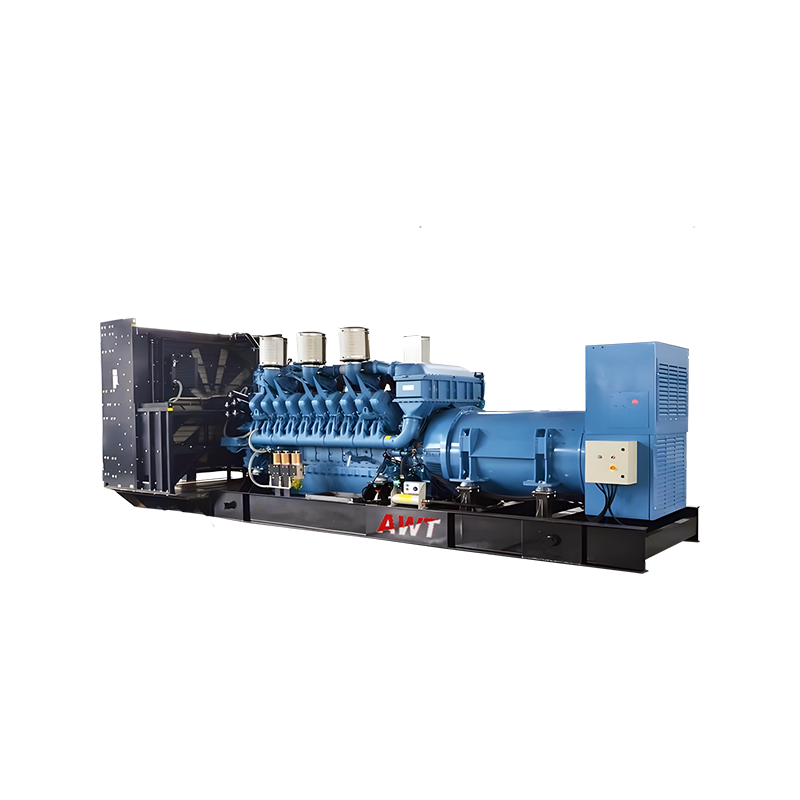
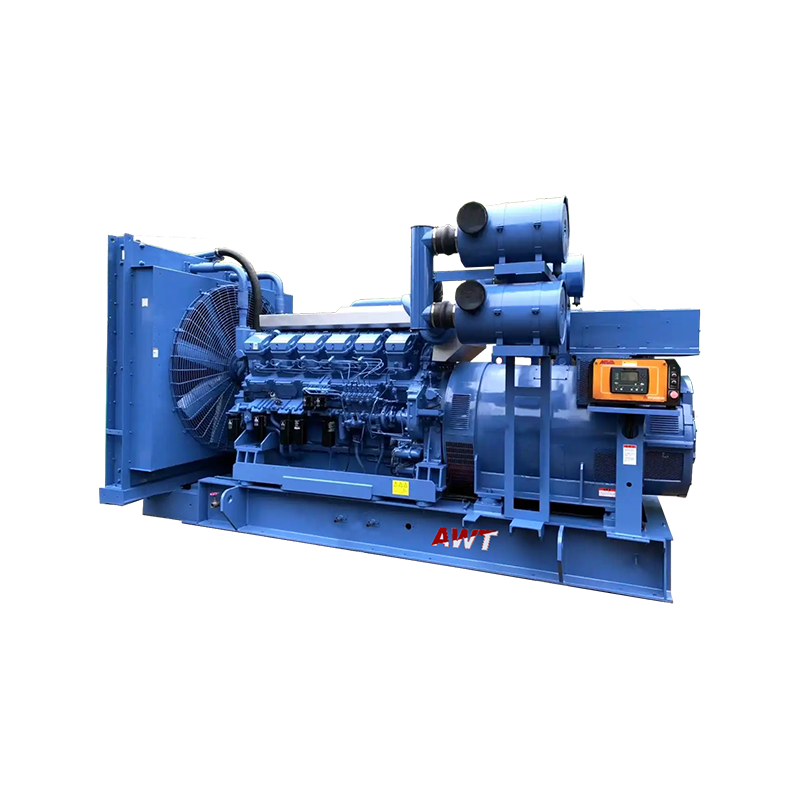 1000–2500 kVA Universal Heavy-Duty Diesel Generator SetsThis ultra-high-power series is designed for full-load continuous operation and extreme load impact. Given the prime-load margin discussion above, it suits applications where average load exceeds typical standby limits.View Product →
02Engine Specification: Speed, Displacement and Fuel Use
In the 1000-2500 kVA class, the engine runs at 1500 rpm for 50 Hz grids or 1800 rpm for 60 Hz grids and is normally a turbocharged, charge-air-cooled V12, V16 or V20 four-stroke diesel with 20 to 60 liters of displacement.
The engine decides the set's continuous capability and its lifetime fuel and oil bill. Sets in this power band are built with Baudouin, Cummins, Mitsubishi, MTU, Perkins, SDEC, Volvo, Weichai and Yuchai engines, so the procurement team can match the set to the engine brand that the regional service network supports best.
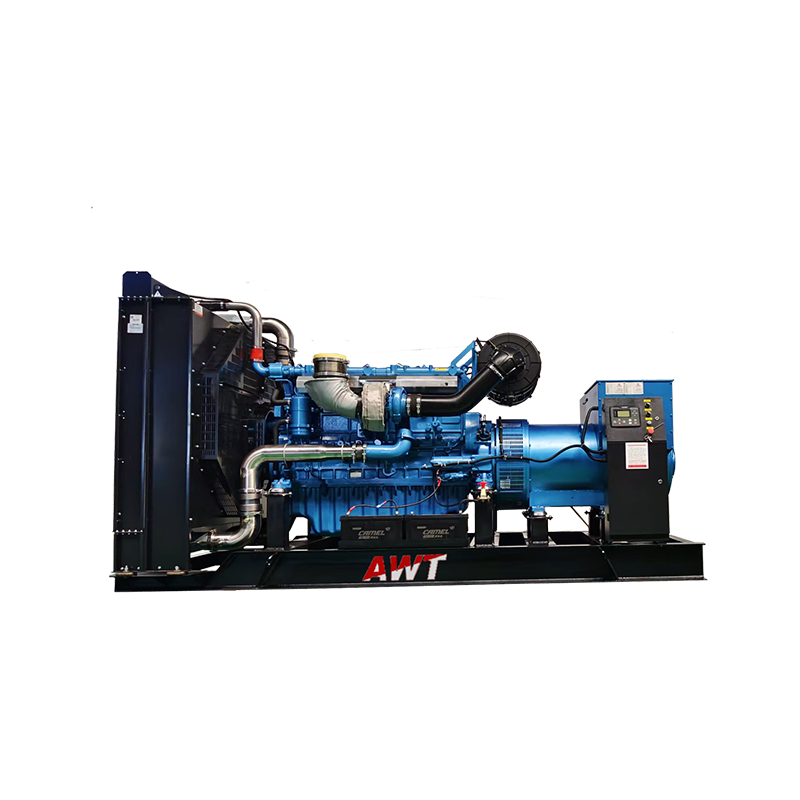
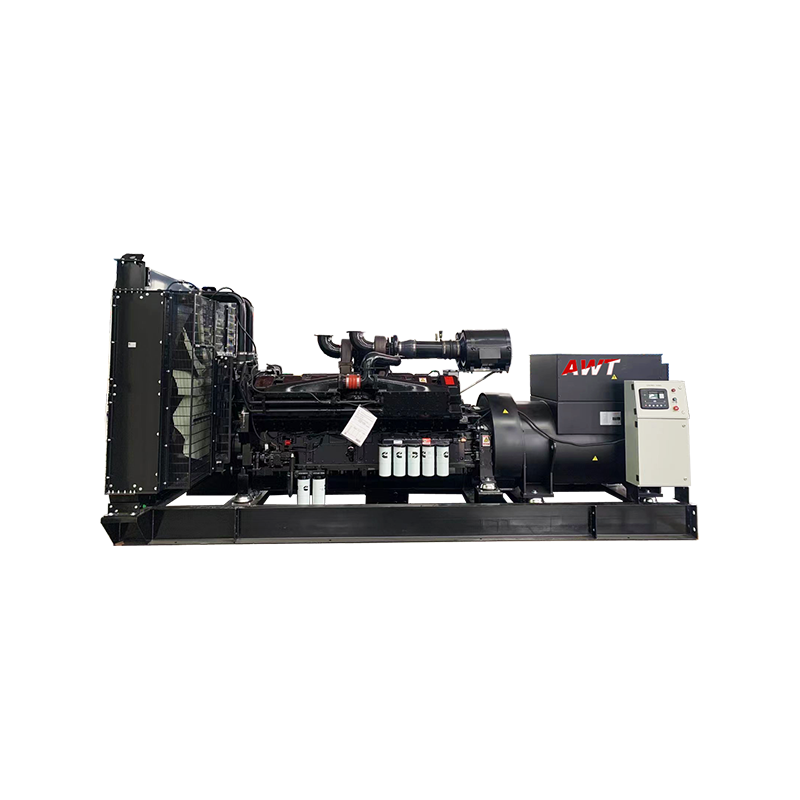 Cummins-Powered Diesel Generator Sets for Critical PowerFactory-built with genuine Cummins engines and full-copper alternators, this range covers 8–3750 kW. The preceding text highlights engine brand selection for regional service support, making this a practical option for data centers and industrial sites.View Product →
- Specific fuel consumption at 75% load, typically 200 to 220 g/kWh, because most prime sets run below full load in normal operation.
- Lubricating oil consumption in the range of 0.1 to 0.2% of fuel consumption, roughly 0.3 to 0.6 L/h on a 1500 kVA set at full load.
- B10 overhaul life in operating hours, the point at which 10% of engines in a production population may require major service.
- Cold-start capability and the scheduled maintenance interval in run hours for oil, filters and valve checks.
At a specific fuel consumption of 210 g/kWh, a 1500 kVA set at 100% prime load, equal to 1200 kWe at 0.8 power factor, burns about 250 kg of diesel per hour, or roughly 300 L/h. At 75% load the figure falls to about 220 L/h.
Estimated diesel use per hour by set rating
Liters per hour, steady state, based on 0.8 power factor, 210 g/kWh at 100% load, 202 g/kWh at 75% load and diesel density of 0.835 kg/L.
03Alternator and AVR: Voltage Regulation and Load Compatibility
Specify an IEC 60034-1 alternator with class H insulation and a digital AVR holding steady-state regulation to +/-0.5%; for VFD, UPS or data-center loads, add a permanent magnet generator (PMG) excitation system.
The alternator is rated at 0.8 power factor lagging, 40 degrees C ambient and a 125 K temperature rise, the standard basis for this power class. The ISO 8528-5 performance class defines how the set reacts to load steps: G2 is the common floor for general loads, while G3 is specified for computer-linked processes.
| Performance limit | Class G2 | Class G3 |
| Transient voltage deviation | 20% or less | 15% or less |
| Voltage recovery time | 5 seconds or less | 3 seconds or less |
| Transient frequency deviation | 10% or less | 7% or less |
| Frequency recovery time | 5 seconds or less | 3 seconds or less |
| Typical loads | Motors, heaters, transformers | VFDs, UPS, data processing |
Linear load profile
Motor, pump, compressor and resistive heater loads are relatively tolerant. Class G2 with a standard self-excited alternator is usually acceptable once motor-starting voltage dip is checked.
Non-linear load profile
Variable-speed drives, UPS rectifiers and IT loads distort the waveform. Specify class G3 with PMG excitation, and confirm the alternator can sustain about 3 times rated current for 10 seconds to clear faults.
RFQ rule: when non-linear load exceeds 30% of the set rating, move the alternator specification to G3 with PMG rather than relying on a standard AVR to correct waveform distortion.
04Cooling, Fuel Supply and Site Derating
Beyond the ISO 3046-1 reference conditions of 25 degrees C ambient, 100 m altitude and 30% relative humidity, the usable output of a diesel set falls; many turbocharged engines derate roughly 1% per 100 m above 1000 m altitude, so state the site elevation and ambient temperature in the RFQ.
Cooling design: the radiator and alternator fan reject most of the fuel energy as heat. A common guideline is to size fresh-air openings at 1.2 to 1.5 times the radiator air flow and to keep at least 1 m of clearance around the set so hot exhaust air cannot recirculate into the inlet.
Fuel supply: for 8 hours at full load, a 1500 kVA set needs roughly 2400 L of diesel; base-mounted tanks in this class are therefore often sized at 2000 to 3000 L. For extended operation, add an external day tank with a transfer pump and a low-level alarm.
At 40 degrees C ambient and 1000 m altitude, combine the engine derate curve, the alternator temperature-rise class and the radiator performance curve. The lowest of the three values becomes the real site rating and should govern the generator set specification.
05Enclosure, Noise and Site Integration
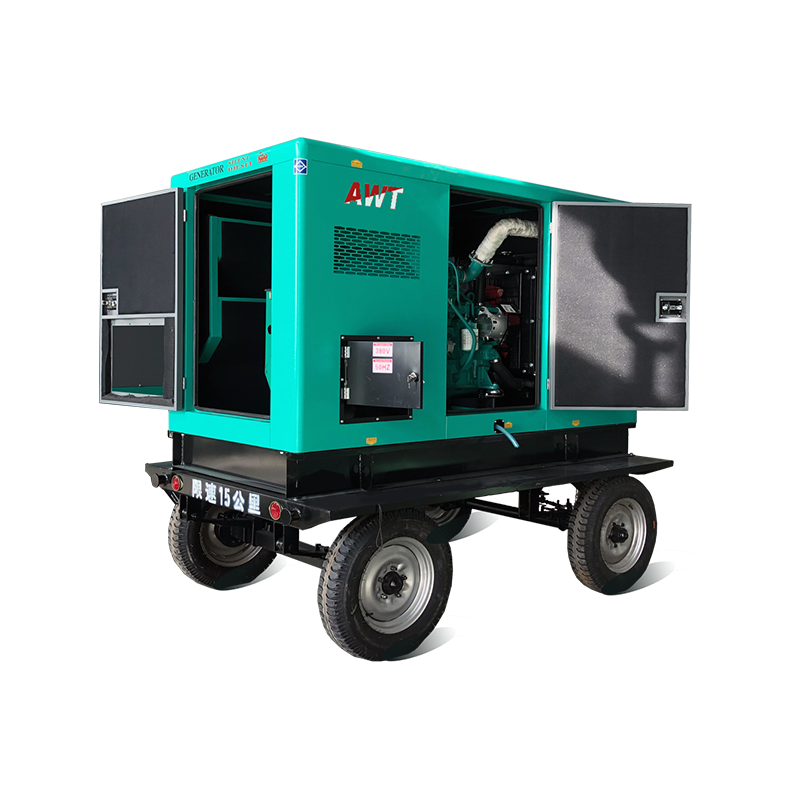
A 1000-2500 kVA genset ships as an open skid unit, a silenced enclosure, a containerized module or a trailer unit; the choice changes noise, access, footprint and transport logistics more than it changes the engine-alternator pair.
| Physical form | Typical noise dB(A) at 7 m | Maintenance access | Typical deployment |
| Open skid | 85 to 95 | Excellent | Existing machine room |
| Silent enclosure | 65 to 75 | Moderate | Outdoor, noise-sensitive site |
| Containerized | 70 to 80 with acoustic pack | Good | Rapid deployment, secured site |
| Trailer mounted | 75 to 85 | Moderate | Mobile power and rental fleet |
Container length follows the set, not the kVA number alone: 1000-1500 kVA sets frequently fit a 20 ft ISO container, while 2000-2500 kVA sets with a large radiator and day tank usually require a 40 ft high-cube unit. Confirm the overall dimensions before the purchase order.
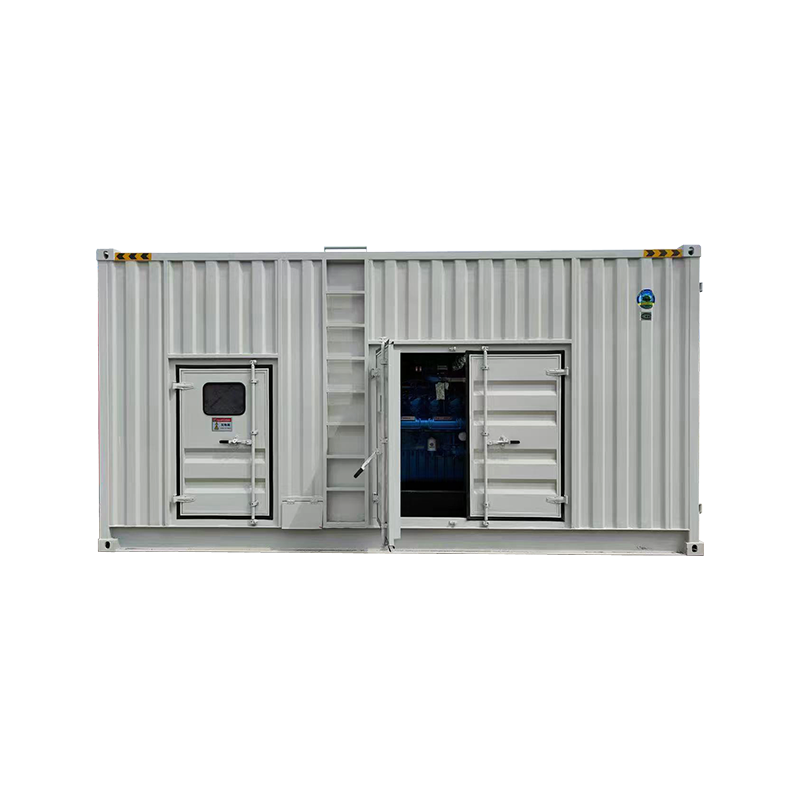 Containerized Diesel Generator Sets for Outdoor InstallationsPre-assembled in 20 ft or 40 ft ISO containers with silencing and ventilation systems, this series supports fast deployment in remote or harsh environments. The nearby text also notes matching container size to kVA class and specifying control logic.View Product →
06Controls, Paralleling and Protection
Specify a digital genset controller with auto-start and auto-mains-failure (AMF) logic, remote telemetry and a defined protection relay list; the control system decides whether the set behaves as a backup source or a base-load plant.
A set in this class normally ships with these minimum protection functions:
- Low engine oil pressure shutdown
- High coolant temperature shutdown
- Overspeed shutdown
- Over and under voltage protection
- Over and under frequency protection
- Earth fault and alternator short-circuit protection through the output breaker
When sets will run in parallel, add droop and load-sharing capability, and require a factory synchronizing test with soft load transfer. The ISO 8528-5 step-load limits apply per machine even in multi-set configurations.
07FAT, Documentation and Customization
Before shipment, a 1000-2500 kVA set should pass a factory acceptance test (FAT) to ISO 8528-6:2018, including a full-load soak, a 10% overload run for prime-rated sets, and recorded step-load responses from 0 to 60% and 60 to 100%.
- Cold inspection: verify wiring, torque, alignment and nameplate data against the approved drawing set.
- No-load run: check engine rpm, AVR output, governor response and controller alarms.
- Step loads: apply 25%, 50%, 75% and 100% steps and record transient voltage and frequency against the G2 or G3 limits.
- Overload and soak: hold 110% load for 1 hour on prime-rated sets and measure fuel consumption at every point.
- Protection test: simulate low oil pressure, overspeed, overcurrent and earth fault and record trip values and times.
- Report: issue the FAT report, calibration certificates, curve sheets, warranty statement and spare parts list.
Yangzhou Aiweite Electromechanical Co., Ltd. builds these sets as standard catalog machines or as custom OEM and ODM packages, with custom genset packaging and labeling agreed before production starts.
08Straight Answers on Large Genset Procurement
How much diesel does a 1500 kVA diesel generator set use per hour?
A 1500 kVA set at 0.8 power factor delivers 1200 kWe. At 100% prime load with a specific consumption near 210 g/kWh, it burns about 250 kg per hour, equal to roughly 300 L/h at a diesel density of 0.835 kg/L. At 75% load, consumption drops to about 220 L/h, the figure to use for operating-cost models.
What is the difference between standby and prime rating on a 2000 kVA set?
Standby (ESP) permits no overload and caps the 24-hour average at 70% of rated output. Prime (PRP) allows 10% overload for 1 hour in 12 and a 24-hour average up to 80% of rated output. A 2000 kVA set quoted as standby is normally around 1800 kVA prime, so a load study demanding 2000 kVA prime cannot be met by a 2000 kVA standby machine.
When should the alternator be specified with PMG excitation?
Specify PMG when the set feeds variable-speed drives, UPS systems or rectifier loads that distort the output waveform. PMG keeps the AVR supply independent of terminal voltage, supports motor starting with deeper voltage dips, and provides roughly 3 times rated short-circuit current for 10 seconds to operate downstream breakers.
What documentation should the supplier submit with the genset?
The package should include the technical datasheet with engine and alternator curve sheets, a FAT report to ISO 8528-6:2018 with measured step-load responses and fuel consumption, protection set-point records, applicable compliance declarations, the warranty document, and a recommended spare parts list.
The procurement specification is the contract: state the ISO rating, site ambient conditions, load class, enclosure form and FAT schedule in writing before the order is placed.